



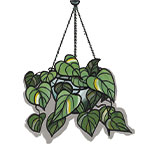


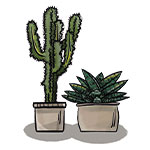
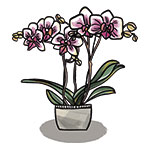
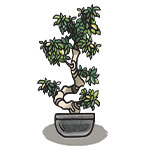



















 Houseplants
 Gift voucher
 Repotting videos
Houseplants improve the indoor climate
Houseplants undoubtedly improve the indoor and working climate, filter pollutants, increase humidity and produce oxygen.
The green thumb
The basics of houseplants are part of every plant lover's general knowledge. For healthy and attractive plants in your home, you should take the time to read through the green thumb guide for houseplants and take it to heart. Basically, all plants have the same general needs: above all, they need light, water, air, nutrients in mineral form and a temperature range suitable for the respective plant genus.
Despite these shared basic needs, the specific requirements of plants differ. Depending on its natural habitat, a houseplant needs low, medium or high humidity, strong sunlight, bright light or a shady spot, more or less water, different temperatures, few or many nutrients, and acidic or alkaline soil. Although many plants are very adaptable, shade-loving genera will thrive just as poorly in direct sunlight as tropical plants in a flat that is too cold. As there is no one-size-fits-all care for all houseplants, we have put together the growing requirements of the individual houseplants for you.
Photosynthesis
The processes that are important for the life and healthy growth of a plant are based on photosynthesis (assimilation). Photosynthesis begins when light acts on the green pigment chlorophyll in the leaves and stems. Photosynthesis provides plants with the energy they need for nourishment. Even the non-green leaves of a plant always contain green chlorophyll; the green is masked by the other pigments, and often the chlorophyll is only present in smaller amounts. Many plants therefore need a bright location to grow healthy and strong. However, this does not mean that every plant should be put straight into full sun. Direct sunshine, especially during the midday hours, is tolerated by only a few plants kept indoors.
Nutrient supply
The energy absorbed by the plant during photosynthesis converts simple elements into a whole range of nutrients important for plant growth, leading to the formation of sugar and other important organic compounds. Two elements important for plants to build sugar are carbon dioxide and water. The plant takes in carbon dioxide from the air through its leaves, and absorbs water from the soil through its roots. Although carbon dioxide and water are crucial basic elements, they are not sufficient to build sugar. Every plant also needs inorganic substances (minerals) present in the soil; these are absorbed together with the water through the roots and transported to the leaves. Fresh soil contains these nutrients in sufficient quantities. As soon as the nutrients are used up, you should start fertilising the plants in a balanced way. Conclusion: balanced fertilising is important for vigorous plants.
Plant roots
Plant roots absorb the water and minerals they need through the fine root hairs at the root tips. As long as a plant grows above ground, its roots continue to spread too. As it develops and the plant gets bigger, it needs more and more moisture. To meet its increasing water requirements, the plant develops an ever larger root system. The water absorbed from the soil by the roots also contains the minerals the plant needs. Inside a plant are parallel, elongated vascular bundles. In these channels, the unprocessed minerals are transported together with the water from the roots to the leaves. Other vascular bundles then carry the nutrients or building materials processed by the leaves back to the roots.
Plant respiration
The stomata on the leaves are used for respiration: on the undersides of a plant's leaves are tiny pores called stomata. Through these openings, the plant takes in carbon dioxide and water vapour from the air during photosynthesis and releases oxygen and moisture. The plant's respiration in the dark also takes place through these complex pores. Now the plant takes in oxygen and releases carbon dioxide in return; no photosynthesis takes place during this time. During respiration, the plant loses moisture: depending on external conditions, the stomata can open or close. As carbon dioxide is present in the air only in small quantities, the stomata must be wide open while the leaves are absorbing light. Depending on the ambient humidity, the plant can lose large amounts of water from the stomata through evaporation (transpiration). If the roots cannot find enough water in the soil to make up for the evaporation loss, the plant quickly suffers from a lack of water and begins to wilt. High humidity is important: to keep a houseplant's water loss as low as possible, the humidity around potted plants should be kept as high as possible. If the air is sufficiently enriched with water vapour, evaporation losses are low, as the more saturated air can absorb only a little additional water. Plants from dry desert regions are an exception; these are mostly cacti and other succulent plants.